Operations · Implementation · AI-directed systems

I research, operate, and create solutions small businesses actually use.

I’m Christopher Sanchez, an economics graduate in Sacramento. I lead the rollout of business systems that AI coding agents build under my direction: I write the spec, review the work, and own the result. Two are in daily use. My family’s janitorial company runs on one, and an online photocard shop launched on the other.

21% → 84%

of invoices made in the new system, after I rebuilt it around how the owners work

$1M+

in live invoices (1,191 of them) migrated from QuickBooks and spreadsheets, matched to the cent

229 cards

sold in the first 24 hours of a photocard shop’s launch

Selected work

Two businesses, running on systems I led.

American Janitorial Services

Operations & Systems Lead · 2025–present

The owners worked around the new system. So I rebuilt it around them.
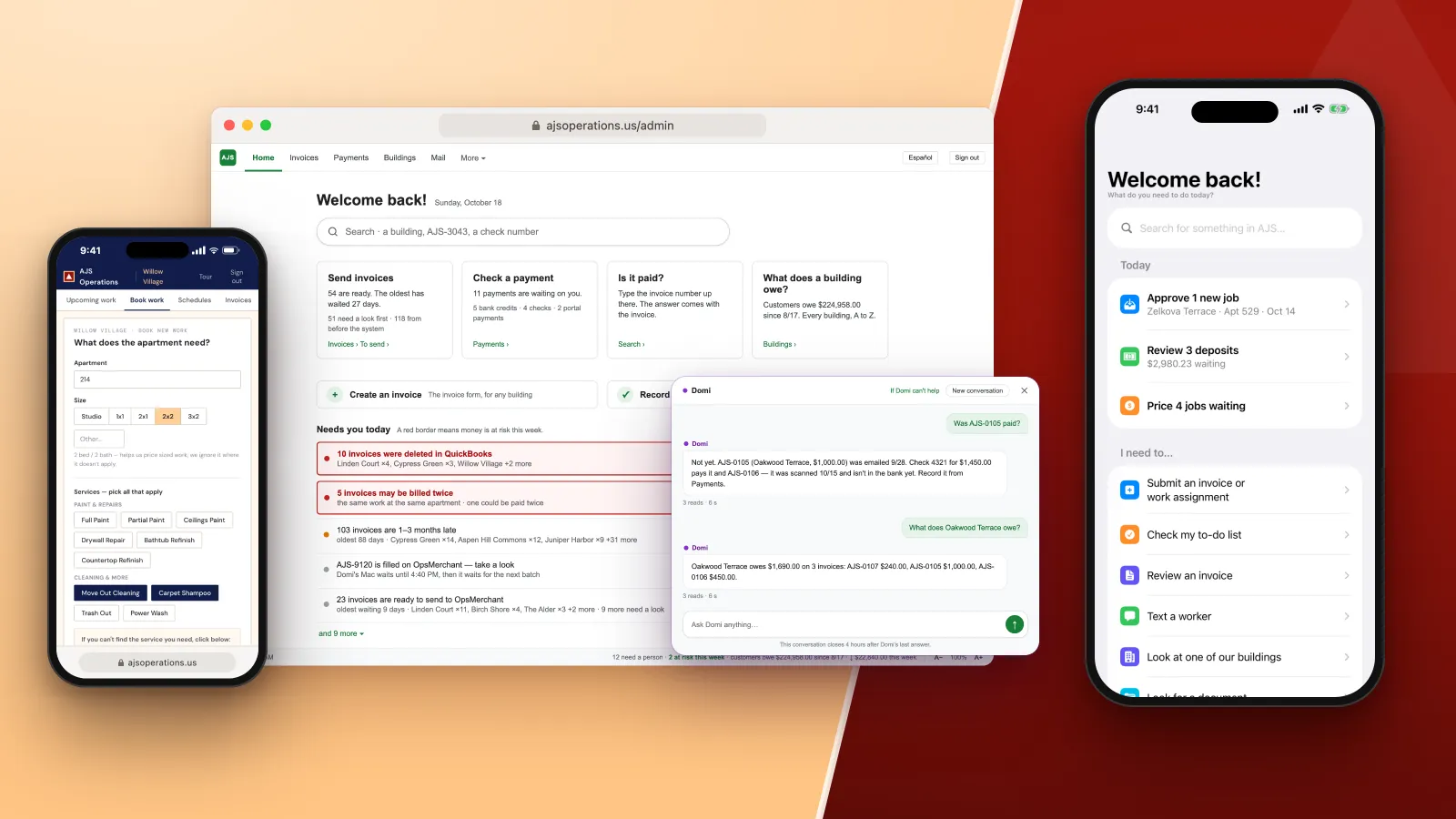
The AJS Operations system on an iPhone, a web admin dashboard with the Domi assistant open, and the owners’ iPhone home screen.
Work orders → dispatch → invoicing → QuickBooks → payments, on web, iPhone, and desktop. Buildings and amounts here are invented.

Built with

  • Claude Code
  • Claude API
  • Supabase
  • QuickBooks
  • Plaid
  • Twilio
  • Resend
  • Firebase
  • Cloudflare
  • Swift
  • Apple Vision
  • OpenAI evals

The problem

My family’s commercial janitorial company went live on its new operations system in August 2026. Seven weeks later, only 21% of invoices (68 of 319) were being made in it. The rest were still typed by hand in QuickBooks and Excel.

What I did

Sorted all 251 bypassed invoices by cause, then rebuilt intake to mirror the QuickBooks and Excel screens the owners already knew. Wrote the training: an English/Spanish iPhone handbook, a 16-stop practice tour in the owners’ own words, and a fully Spanish admin interface.

The result

By the week of October 12, 84% of invoices (27 of 32) were made in the system. The migration behind it moved 1,191 live invoices ($1M+) over, matched to the cent, and closed a $161K reconciliation gap.

An assistant with guardrails

Domi, the built-in assistant, drafts invoices and payment matches. A person approves each one, and every figure comes from the database rather than the model. The owners’ first 18 questions were all rated helpful, at about 10¢ each.

Graded before it shipped

I ran a blind-graded evaluation of four assistant setups: 240 answers, graded with the labels hidden. The one in production made the fewest critical errors (2, against 5–8 for the others).

An audit that paid for itself

Auditing 14,967 historical invoices turned up $14,395 in double bills, now voided.

Everywhere the owners work

Web, iPhone, small Mac and Windows helpers, and a Chrome extension, built by AI coding agents through 52 versions.
Navi’s PC Cafe

Product & Platform Lead, freelance · 2026–present · navipcshop.com

The best feature was the owner’s idea.

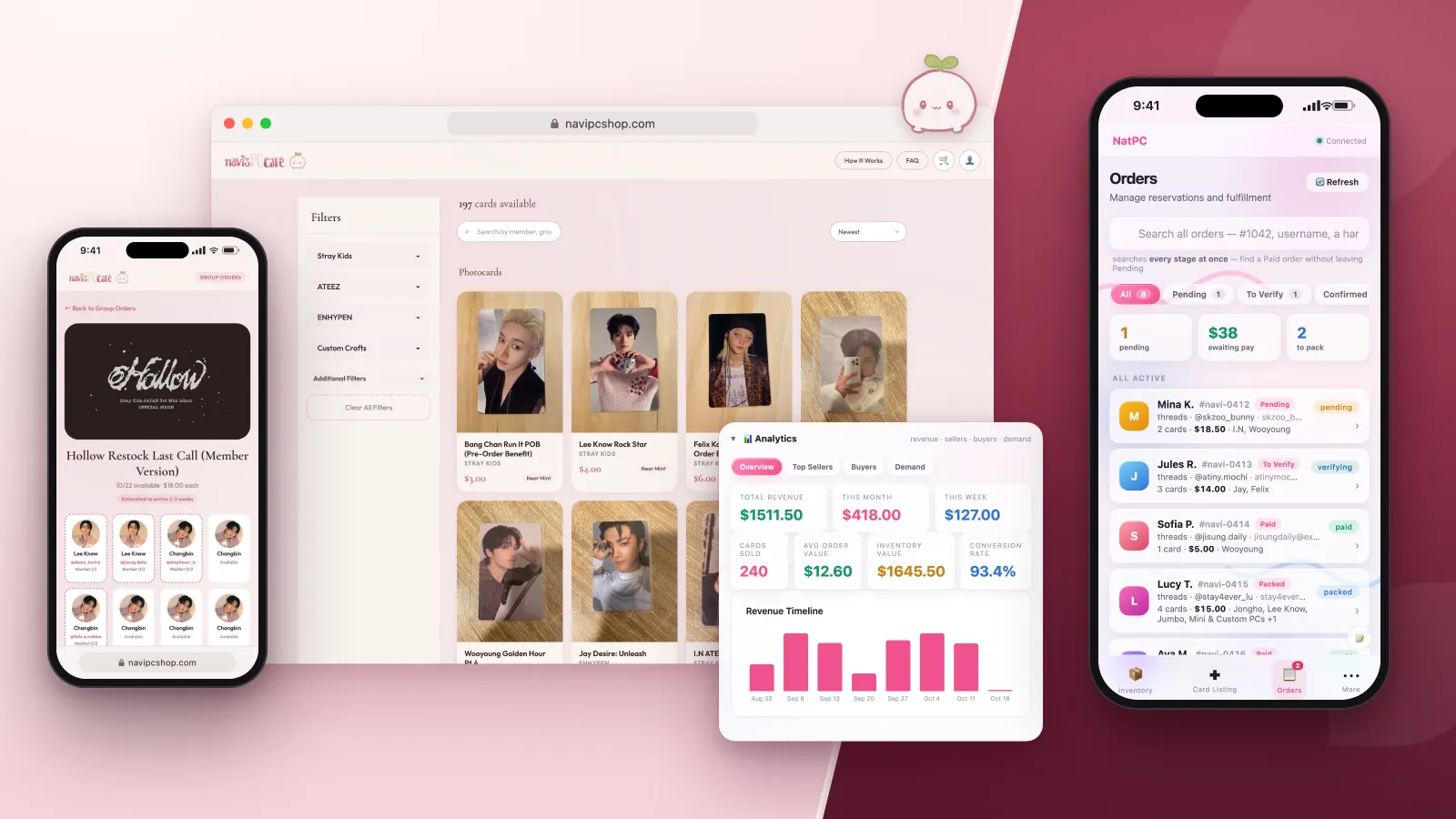
Navi’s PC Cafe: the photocard storefront on desktop and iPhone, a sales analytics card, and the owner’s iPhone order manager.
Storefront, group orders, card checkout, and the seller’s admin. Buyers, listings, and sales figures here are made up.

Built with

  • Claude Code
  • Supabase
  • Stripe
  • OpenAI
  • Gemini
  • Resend
  • Cloudflare
  • Swift
  • Apple Vision

The owner

A K-pop photocard seller with a community of about 300 members and no technical background. She needed a shop, a way to run group orders, and an admin panel she could work from her phone.

What I did

Built all three, then onboarded her with plain-English guides and three rounds of feedback. One of her suggestions, “Tinder, but for prices,” became the price review: swipe to approve each suggested price.

The launch

$3,300+ in orders from 100+ buyers across 14 group orders. The first drop sold 229 cards in 24 hours.

Snap, stack, priced

305 cards in one day

On the older version of the system, uploading and pricing 100 took her about three days, she says.

At her request, the admin is moving to a native iPhone app. She shoots cards back to back; the phone straightens each photo and pairs every front with its back (93% right on 160 of her real cards), and one tap sends the batch to AI pricing and her swipe review. Four AI agents built the first version in parallel overnight. It’s still a test build, and she’s already using it for real batches.

Priced like her, tested like an experiment

To choose the AI that matches her cards to online listings, I tested 9 setups on 40 real cards, judged 454 disputed matches by hand, and wrote my rules into the prompt. The winner prices 93% of cards right, up from 75%, at about half the cost, still tuned to her own prices.

A metric that was counting the wrong thing

The dashboard’s 64% “conversion” counted cards, not orders. Recomputed, 81% of orders were paid (96% at launch, median 12 hours), which made per-buyer reservation caps a better fit than prepayment.

Ready for crowds and bad actors

Before the shop took card payments, seven AI reviewers audited it: 92 issues flagged, and the 8 high-severity ones closed the same day. Before a big drop, I asked for a second pass and a load test: 25 people reserved a card with 3 copies at once, and exactly 3 got it.

Personal projects

Two experiments I stopped on purpose.

Knowing when a result doesn’t hold up is part of the job. Both were built by AI coding agents under my direction.

Insider Edge · 2026 · concluded

Do insiders’ stock purchases predict returns? Not by enough to trade.

An event study of 71,327 insider purchases filed with the SEC from 2019 to 2024, built to avoid the usual traps: survivorship-free data, entry the day after each filing, trading costs, and a holdout period the model never saw.

One company was inflating the signal

Signal strength (rank correlation between the score and later returns), counted per event vs. one vote per company

Training years (2019–22)

0.11 0.28

Holdout years (2023–24)

0.11 0.16

All years

0.12 0.26

The check I asked for: one company made up 38% of the events in the traded sample. Re-estimated at the company level, the signal fell from 0.26 to about 0.11, and the t-statistics turned out to be inflated about 4.8×. Follow-up ideas on congressional trades and options pricing were pre-registered, and none passed. The conclusion: the remaining edge was too small to trade after costs and taxes.

Estate Tracker · 2026 · paused

A foreclosure screener that ranked the riskiest deals first.

It pulled foreclosure listings, scored each home on eight hand-weighted factors, and wrote English and Spanish summaries with Claude for an iPhone app: 185 homes and 32 ZIP-code reports.

Auction homes, the riskiest buys, scored highest

Average score out of 100, by stage of foreclosure

Auction

76

Preforeclosure

60

Bank-owned

58

What the review found: the foreclosure stage alone was worth 15 points, auctions got full credit, and nothing was subtracted for repair costs, so the riskiest homes rose to the top. I paused it rather than keep a ranking I couldn’t defend. Lessons I kept: hold the AI’s opinion apart from the score, call the model only when the data changes, and cap spending (learned from a $40 runaway-cost incident).

How I work

I specify, review, and own the result.

I don’t write the code. AI coding agents do, under my direction: I decide what gets built, write the spec, review each change, test it against real data, and answer for what ships. A few rules I hold to:

01

The model drafts. A person approves.

Domi drafts invoices and payment matches. Nothing is sent or recorded until someone presses approve.

02

Numbers come from the database.

Every figure the assistant shows is pulled by code. The model only puts it into words.

03

Measure before trusting.

Blind-graded evaluations before an assistant goes live. Security audits and load tests before a shop takes payments or a big drop.

04

Stop when the evidence says stop.

I wound down Insider Edge and paused Estate Tracker when the checks said they didn’t hold up.

05

Every session leaves notes for the next.

An agent forgets everything between sessions, so each project keeps its memory in plain files: the plan, a log of decisions, and handoff notes. That’s how AJS held together through 52 versions.

06

A thinking partner, not a vending machine.

I ask for a mockup before anything is built and for the reasoning behind each choice, then push back. The company-level check that deflated Insider Edge started as my question.

Research

Learning to distrust a good result.

Three papers from UC Davis, then a project. Read in order, each one asks more of the evidence than the one before.

  1. Fall 2024 · ECN 140, Econometrics · Early beginnings

    The Effect of Remote Work on Productivity

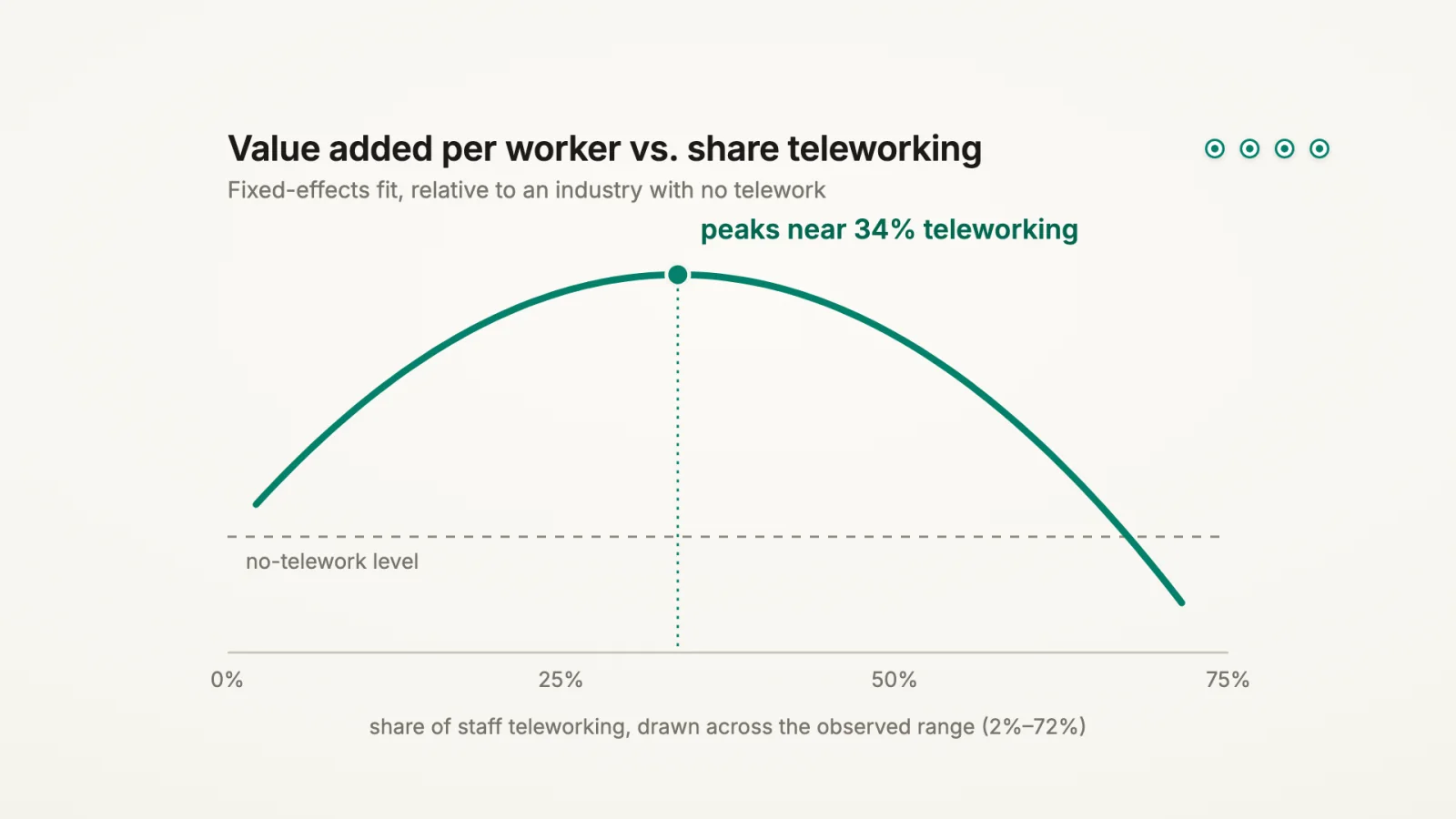
    Chart from the paper’s fixed-effects model: value added per worker rises with the share of staff teleworking, peaks near 34%, then falls, drawn across the observed range of 2% to 72%.
    The paper in 19 seconds: question, data, methods, result.

    My first dataset built from scratch: an industry-by-month panel for 2023 assembled from BLS, BEA, and Census sources, 23 industries. I moved from plain OLS to industry fixed effects. Output per worker rose with telework up to about a third of staff working remotely, then fell, and was higher in industries where remote work is practical.

    • Building a panel
    • OLS
    • Fixed effects

    Looking back

    What I’d fix today: the monthly figures were filled in from quarterly data, so the real sample is smaller than it looks and the standard errors should have been clustered. The industry fixed effects also absorb the industry-type variable. Posted as submitted.

  2. Winter 2025 · ECN 142 · Maturing

    Predicting Employee Happiness

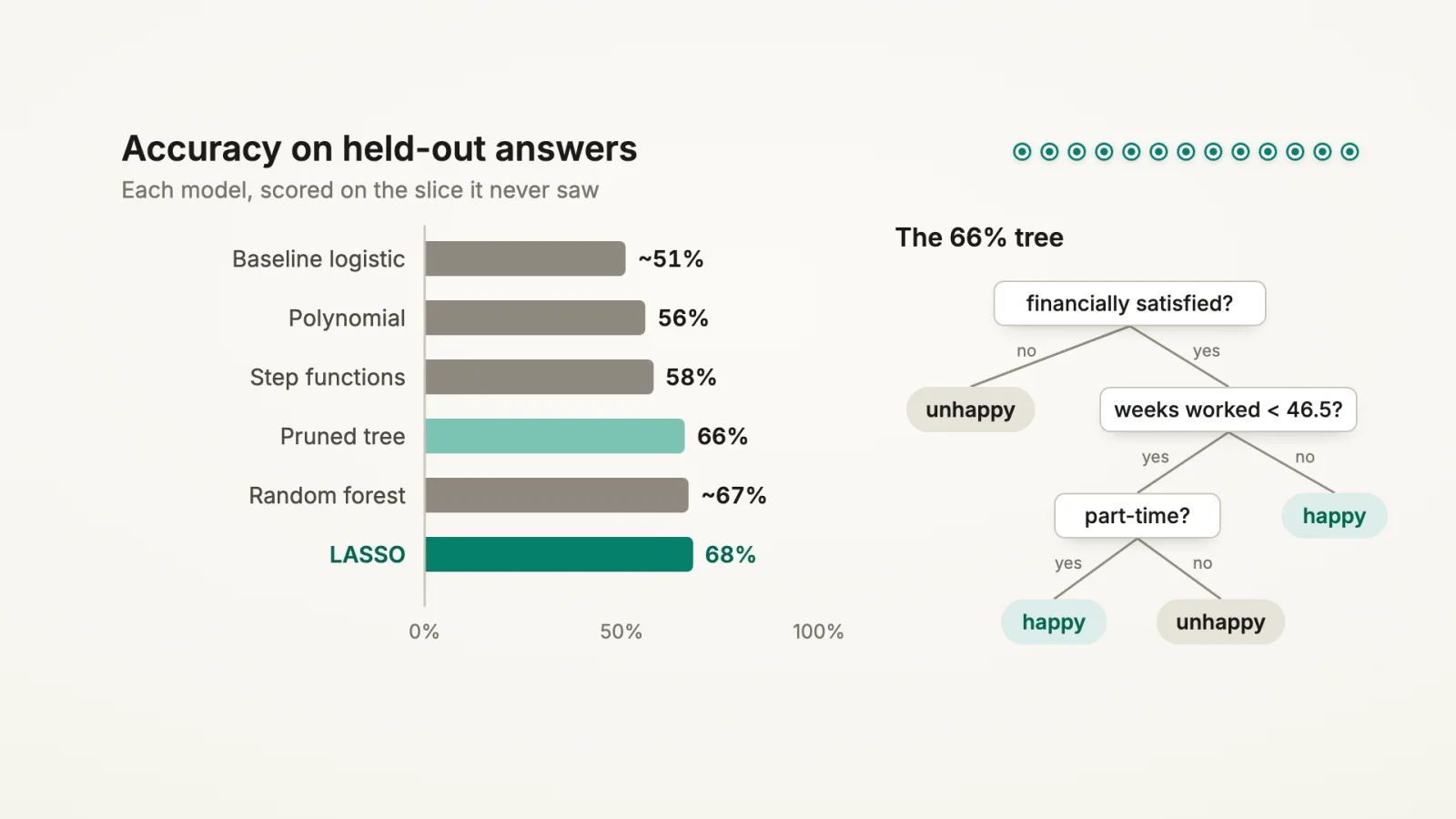
    Accuracy on held-out answers: baseline logistic about 51%, polynomial 56%, step functions 58%, pruned tree 66%, random forest about 67%, LASSO 68%. Beside it, the pruned tree asks whether someone is financially satisfied, whether they worked under 46.5 weeks, and whether they work part-time.
    The paper in 19 seconds: question, data, methods, result.

    Can a survey predict who is happy at work? From the 2022 General Social Survey, I balanced a sample that skewed heavily happy (300 of 844 complete responses), then compared logistic models, PCA, LASSO, and a pruned decision tree on data they hadn’t seen.

    68% out-of-sample accuracy with LASSO, up from about 51% for a plain logistic model. The strongest predictors were job satisfaction, financial satisfaction, full-time status, and weeks worked.

    • Building a panel
    • OLS
    • Fixed effects
    • Logistic regression
    • LASSO
    • Decision trees
    • PCA
    • Out-of-sample testing
  3. 2025–26 · Honors thesis, ECN 194HB · Capstone

    Household Expenditures & Fuel-Efficient Vehicles

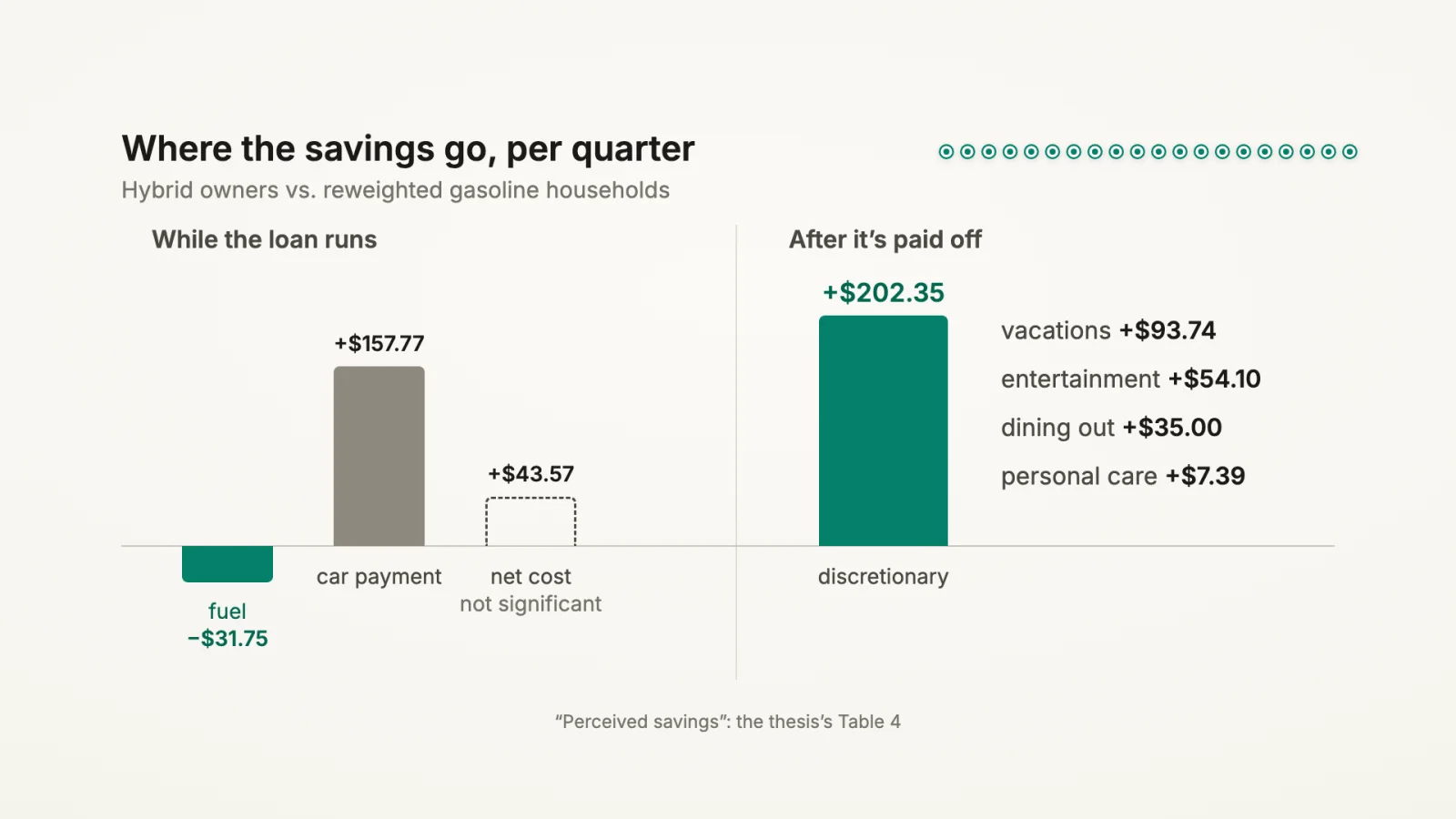
    Where the savings go, per quarter: while the car loan runs, hybrid owners’ $31.75 in fuel savings is outweighed by $157.77 higher car payments, a net +$43.57 that is not significant; once the car is paid off, discretionary spending rises $202.35, led by vacations, entertainment, and dining out.
    The thesis in 22 seconds: question, data, methods, result.

    Do hybrids and EVs actually leave households better off? I built a ten-year household panel from the Consumer Expenditure Survey (2013–2023), reweighted comparable gasoline households to match each hybrid and EV group (entropy balancing), and estimated the effects with weighted regression and difference-in-differences.

    Hybrids cut fuel spending by about $31 a quarter, but higher car payments cancel the savings until the loan is paid off. After that, owners spend more on themselves: a “perceived savings” effect. When gas prices spiked in 2022, hybrid savings roughly doubled.

    Hybrid owners’ fuel savings, and the test that guards them

    Dollars saved per quarter vs. matched gasoline households, with 95% confidence intervals

    Everyday fuel savings $31.75

    Extra savings in the 2022 price spike +$32.01

    Placebo: a fake spike in 2018 not significant

    The placebo matters: a fake “spike” in a year with no real price shock shows no significant effect, so the 2022 savings aren’t just noise. Source: thesis tables 4 and 8; standard errors clustered by household.
    “The fuel-efficient market is a walled garden, with a steep barrier to entry.”
    • Building a panel
    • OLS
    • Fixed effects
    • Logistic regression
    • LASSO
    • Decision trees
    • PCA
    • Out-of-sample testing
    • Causal inference
    • Entropy balancing
    • Difference-in-differences
    • Placebo tests
    • Clustered errors
    • Stata & R
  4. 2026 · Epilogue

    The methods leave school.

    In Insider Edge I held out years the model never saw, pre-registered every follow-up test, and asked for the company-level clustering check that cut the signal from 0.26 to about 0.11. It’s the same gap my ECN 140 note admits, this time caught before it mattered.

    • Everything above
    • Holdout testing
    • Pre-registration
    • Company-level clustering

About

Hi, I’m Christopher.

I graduated from UC Davis in June 2026 with a B.A. in Economics: Phi Beta Kappa, departmental honors, and a specialization in Data Analytics and Economic Analysis.

I did the invoicing for my family’s janitorial business from 2017 to 2022, and since 2025 I’ve led its operations and systems. I’m studying for the IRS Enrolled Agent exam (target: 2027), and I read Spanish, which is how I reviewed the bilingual training material.

I’m looking for implementation, onboarding, and AI-operations roles.

Sacramento, California

Open in new tab Download